In December 2025, NATO signalled an increased commitment to developing military-grade artificial intelligence (AI) through its selection of companies for the Defence Innovation Accelerator for the North Atlantic (DIANA) 2026 cohort. Several of the companies selected are dedicated to building military AI technologies, including AI-assisted decision-making tools, AI-powered autonomous drones, and AI cyberdefence capabilities for unmanned systems. These tools have tactical benefits for the Alliance’s defence capabilities, such as improved resource distribution, faster threat detection and decision making, and greater precision in targeting. However, concern has been raised over the capacity of these data-based systems to perpetuate or amplify existing gender bias, the systematic inclination against certain individuals based on their gender. These systems pose the risk of misidentification or mistargeting that may disproportionately harm women. As NATO furthers its commitment to military AI development, it must equally commit to monitoring how these systems reproduce gender bias and developing corrective frameworks for responsible use consistent with both its AI Strategy and obligations under the Women, Peace and Security (WPS) agenda.
Bias has the potential to enter military AI systems through data and algorithms at multiple stages of development. AI machine learning identifies correlations in large datasets to model human processes, and encodes the patterns and prejudices found, all the while taking training data conditions as given. This means stereotypes in the data are readily learned. Results include systems associating domestic roles or undervalued professions with women or image recognition having problems accurately identifying women. Bias is also introduced through human programmers who design proxy indicators, measures used when direct measurement is unavailable, ultimately embedding their own assumptions into the machine’s structure. Consequences of this bias in a military context can be severe: recruiting algorithms may pass over female candidates due to historically low female participation in the military, or a voice system could fail to recognize a female military personnel’s voice. Further, AI-informed targeting on the battlefield could mistake civilian men as combatants, or systems could treat a male body as the universal reference when assessing the physical effects of weapons on people. Without conscious acknowledgement of these consequences, NATO risks embedding bias in technologies it is funding. This directly goes against their Principles of Responsible Use (PRUs) and WPS commitments: the prevention, protection, participation, and relief and recovery for women.
NATO’s 2024 revised AI strategy includes a dedication to six PRUs for AI in Defence, a strategy to lead by example in encouraging the development and use of AI for security purposes in a responsible manner. Among these principles is bias mitigation. The strategy pledges to develop standards, assessment tools, review processes, and good practices to operationalize responsible AI adoption across the Alliance. To facilitate this, NATO established the Data and Artificial Intelligence Review Board (DARB) in 2022 to govern the implementation of PRUs, with a commitment to creating Responsible AI (RAI) certification standards. However, NATO has yet to develop an overarching standard to monitor effective implementation of bias mitigation in military AI. A 2026 NATO Science and Technology Organization (STO) paper proposes a framework to systematically assess AI systems against the PRUs; using URREF ontology, a model for evaluating how automated systems handle indeterminate information. Despite this concrete step forward, measurement gaps remain, including a trade-off between enforcing bias mitigation and maintaining model accuracy. This suggests companies in the DIANA cohort are developing military-use AI technology in the absence of NATO regulations responsible for measuring whether these systems are reproducing bias. Reinforcing the importance of addressing this bias is encoded in NATO’s WPS commitments. The agenda emphasizes integrating gender analyses into all aspects of military operations, and promoting the protection of women and girls, which must extend to the protection of risks generated by biased algorithms due to their potential to harm.
Moving forward, NATO can ensure military AI development respects Principles of Responsible Use. While bias cannot be eliminated entirely from AI systems, it can be mitigated through policy. Training AI systems on representative datasets is an important first step. Addressing who is involved with the development of these systems and including more women experts in technology, as well as scholars of gender and identity who can recognize the ways mimicking human processes through machine models can reproduce bias, is one method that NATO can employ. WPS principles can also be referred to when developing future evaluation frameworks, such as addressing equal participation and determining whether conflict prevention is taken into account in the system’s design. Computer scientist Timnit Gebru suggests accompanying training data with documentation detailing its motivation, composition, collection process, and recommended uses to encourage transparency and accountability in AI models, both of which are additional NATO PRUs. Military users, too, should be trained to identify bias and, at every step, reflect on how their decisions might contribute to harm. Through its AI strategy and the DARB, NATO has laid the foundational groundwork to promote responsible AI. As NATO moves forward with the DIANA 2026 cohort and develops a standardized certification framework for measuring adherence to PRUs, it is clear that it must implement a gender perspective to ensure the Alliance remains true to its commitments.
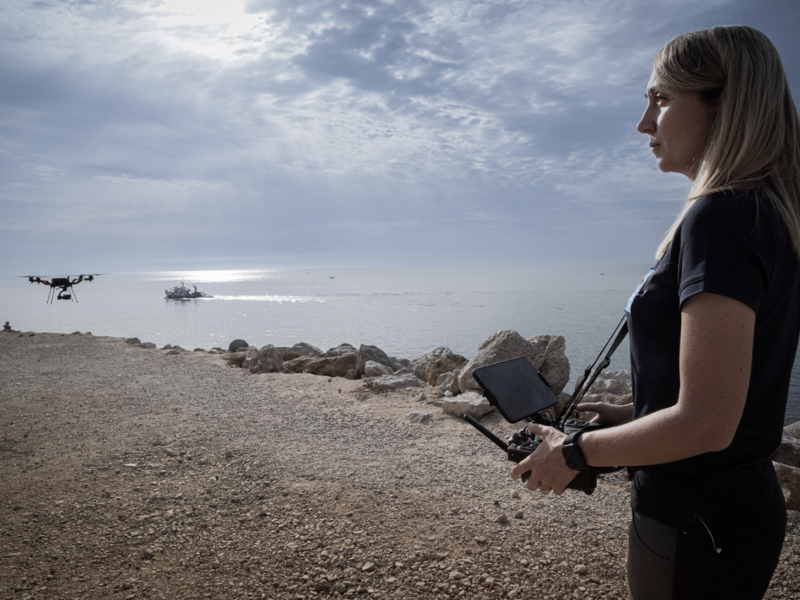
Photo: Crew member flies a drone during REPMUS 2025 (2025). Source: NATO via Flickr. Licensed under CC BY-NC-ND 4.0.
Disclaimer: Any views or opinions expressed in articles are solely those of the authors and do not necessarily represent the views of the NATO Association of Canada.