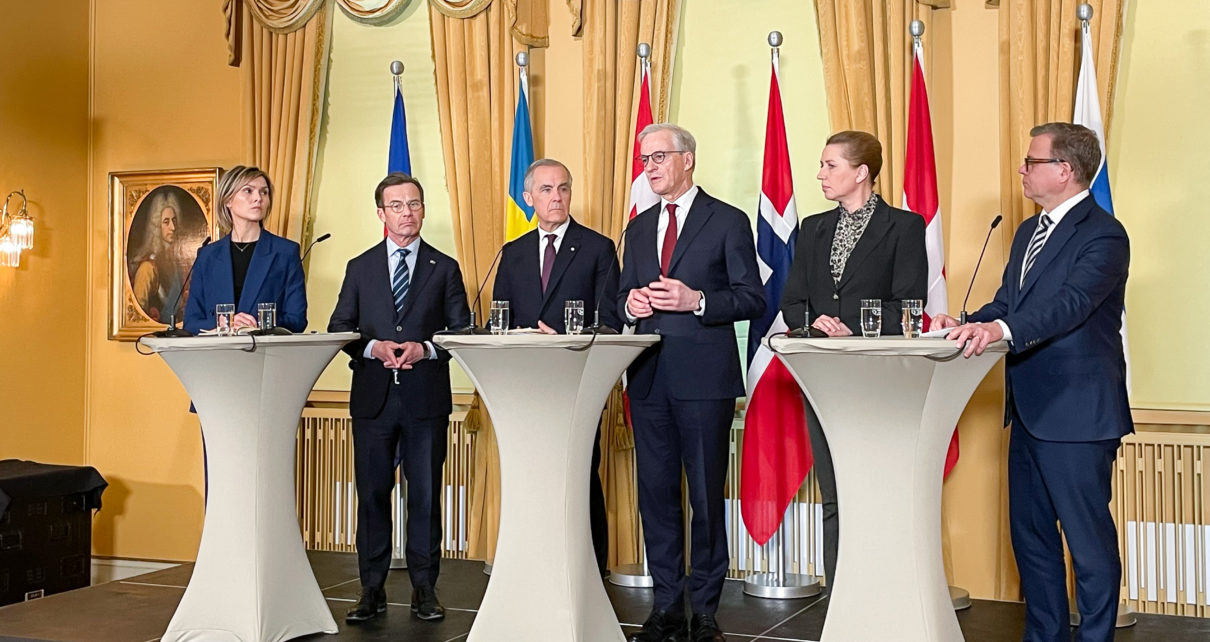
Canada and Norway are, by most accounts, natural allies. Both are Arctic nations, both perch on long coastlines and vast energy reserves, and both face an increasingly unpredictable strategic environment: Norway through its proximity to Russia, and Canada with a more hostile United States. Of all the images to come out of Mark Carney’s Nordic tour this spring, few travelled as well as the one from Bardufoss. The Canadian Prime Minister in the Arctic snow was flanked by Norway’s Jonas Gahr Støre and Germany’s Friedrich Merz, watching 30,000 troops rehearsing the defence of NATO’s northern flank. This image, almost unimaginable a decade ago, signals both the grim fragmentation of the international order and the new battleground to which it has been pushed. To Carney, his presence was simple: “We are much stronger together,” he told reporters. Yet the veil of solidarity quickly gave way to something closer to pragmatic transactionalism, a language the prime minister knows well. The next day in Oslo, both leaders issued a joint statement on strategic cooperation, and the countries signed a memorandum of understanding on critical minerals. On paper, their commitments run both ways, from shared expertise in resource management to technical exchange on mining. The stakes do not. A failed partnership would cost Norway a useful ally, but would leave Canada, far more strategically exposed to a single customer, without a model to reduce that dependence.
The Oslo accord fits a broader energy pattern. Off the Newfoundland coast, Equinor, a Norwegian state-controlled and publicly listed company, is working toward a final investment decision on Bay du Nord, a deepwater project. It agreed in July to buy out the stake held by oil major bp, formerly British Petroleum, and to sell 30% to Shell earlier this month, which would leave Equinor as operator with a 70% stake. Equinor estimates an initial investment of around CAD$14 billion, and a total contribution of about CAD$50 billion to national GDP. For Ottawa, the project rests on Equinor’s call in 2027.
So what’s at stake for Norway? Real, but narrower than it seems. The Norwegian Police Security Service (PST), its intelligence service, assesses that Russian sabotage against Norwegian energy infrastructure is “likely” in the year ahead, particularly pipelines carrying gas to Europe. Whilst indeed a real risk, it is also one NATO membership, and seventy years of Cold War stress-tests were built to manage. And Norway enters the partnership from a more fiscally secure position: when Carney unveiled his CA$25 billion Canada Strong Fund in April, commentators reached for Norway by name, which The Receipts lauds as “one of the most successful state investment vehicles in the world.” Indeed, worth some $2.1 trillion, its Government Pension Fund Global is built entirely on oil revenues under a rule Canada has struggled to impose on itself, instead folding its resource revenue into general government spending. “Prepared, but not afraid” Støre put plainly on Canadian television, a poise Norway’s energy diversification and long-established fiscal rule can afford.
By contrast, Canada’s vulnerability stems from its closest partner, the country its economy was built around, and neither Cold War precedent nor Article V offers a framework for managing it. In 2025, 96.6% of its natural gas exports went to that single buyer, according to Statistics Canada. Even British Columbia, home to the country’s first LNG export terminal, sent barely 7.6% of its gas anywhere else, the first time the province had shipped gas beyond the U.S. at all. Despite his praise, Carney’s Canada Strong Fund continues to run into the pitfalls it was designed to avoid: financed by borrowed money rather than resource revenue, with no published return benchmark. Ironically, critics argue this resembles the loss-making “troubled British fund” Carney himself helped design more than the Norwegian one he pointed to.
There is nevertheless a lot Norway can, and seeks to, gain from this arrangement. Enveloping Canada in a Nordic Five-plus-one gives Norway a larger, wealthier NATO ally anchoring its Arctic flank and a partner Ukraine’s allies can lean on for sanctions enforcement and aid. The same Oslo trip produced a second statement, where Canada and the Nordic countries pledged to “guard against dangerous… dependencies,” widely read as a reference to China, which refines almost three-quarters of the world’s critical minerals, according to the IEA. Canada, holding the world’s third-largest uranium reserves and the largest potash reserves outright, serves exactly the kind of Western supply chain the joint statement describes. Støre explicitly agreed, emphasising this two-way mutual relationship of wants between nations of “substantial resources and robust institutions.”
None of this means solidarity was a lie, just perhaps doing more work for Canada than Norway. What Canada stands to gain is largely what Norway already has: a diversified set of buyers, a fund bound by a spending guideline, and an operator weighing a CAD$14 billion investment in a Canadian project. What Norway is building is narrower but real: a larger NATO ally on its Arctic flank and a Western source of critical minerals. Canada’s contribution to Arctic security has strategic value, but Norway does not depend on it. However, Canada’s first cargo out of Kitimat last July, bound for Asia, is a step in the right direction. Though lopsided, there is a lot on offer for both Arctic nations. As Carney put it himself, Canada certainly “has what the world wants,” though whether it will successfully apply the discipline Norway applies to its resource wealth will decide if it geostrategic ambitions can be met.