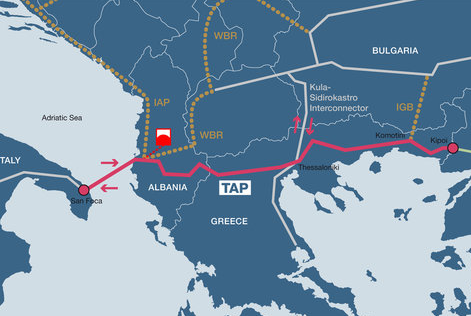
The Trans-Caspian Pipeline (TCP) project from Turkmenistan to Azerbaijan is a geopolitical and strategic pipeline for Europe. It will bring large quantities of natural gas from Central Asia to southern Europe and, via the White Stream pipeline under the Black Sea, also to Central and Eastern Europe. The Baku–Tbilisi–Ceyhan (BTC) oil export pipeline 20 years ago established and reinforced the independence of the participating countries, Azerbaijan and Georgia. It also happened to be commercially very advantageous. Like it, the TCGP is a unique opportunity to ensure Europe’s economic benefit and political influence in the region. Also like the BTC, it is a
demonstration project that will open the broader region to greater international investment. Gas from Turkmenistan costs much less than gas from Siberia. Implementation of Turkmen gas exports to the EU in sizeable quantities will serve the geopolitical purpose of cementing Central Asia’s relations with Europe, promoting integration and stability.
Robert M. Cutler earned his doctorate at The University of Michigan after receiving two Bachelor's degrees from the Massachusetts Institute of Technology. After over a dozen years in leading universities in Canada, France, Russia, Switzerland and the United States, he expanded into policy analysis and consulting as an Energy Security and Geo-economics Specialist. He has over 25 years' experience in international energy diplomacy: advising energy firms, governments, international institutions and NGOs; framing policy and research issues and leading teams to address them, and producing briefings and analytical bulletins.
He has published scores of refereed academic articles, policy articles and book chapters. He Practitioner Member at the University of Waterloo's Institute for Complexity and Innovation (WICI) and Senior Fellow at Strategy International. He is a past fellow of the Canadian International Council and Canadian Global Affairs Institute, and was for many years a senior researcher at Carleton University's Institute for European, Russian and European Studies. He is fluent in English, French and Russian. He can be reached at rmc@alum.mit.edu and posts to X from @RobertMCutler.
Robert M. Cutler earned his doctorate at The University of Michigan after receiving two Bachelor's degrees from the Massachusetts Institute of Technology. After over a dozen years in leading universities in Canada, France, Russia, Switzerland and the United States, he expanded into policy analysis and consulting as an Energy Security and Geo-economics Specialist. He has over 25 years' experience in international energy diplomacy: advising energy firms, governments, international institutions and NGOs; framing policy and research issues and leading teams to address them, and producing briefings and analytical bulletins.
He has published scores of refereed academic articles, policy articles and book chapters. He Practitioner Member at the University of Waterloo's Institute for Complexity and Innovation (WICI) and Senior Fellow at Strategy International. He is a past fellow of the Canadian International Council and Canadian Global Affairs Institute, and was for many years a senior researcher at Carleton University's Institute for European, Russian and European Studies. He is fluent in English, French and Russian. He can be reached at rmc@alum.mit.edu and posts to X from @RobertMCutler.
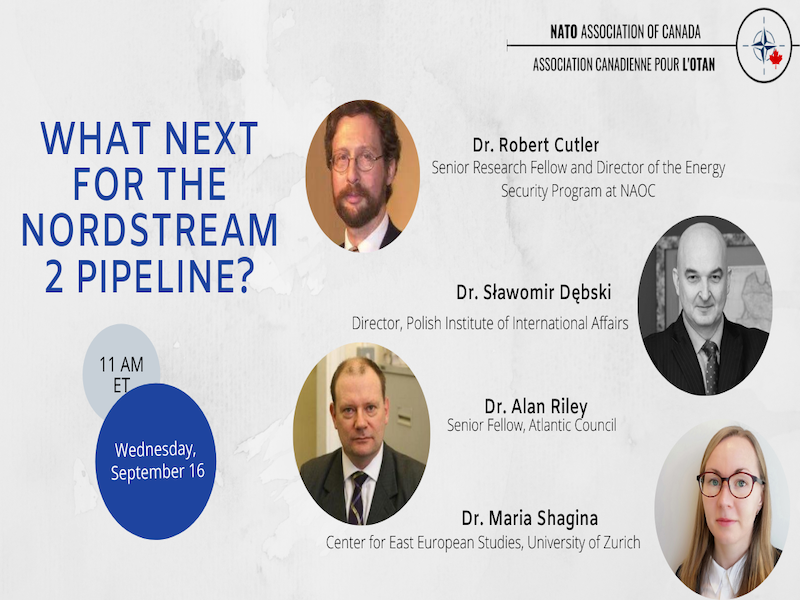
Title: What’s Next for the Nordstream 2 Pipeline?Featured Speakers: Dr. Robert M. Cutler (Senior Research Fellow and Director of the Energy Security Program at NATO Association of Canada), Dr. Sławomir Dębski (Director, Polish Institute of International Affairs), Dr. Alan Riley (Senior Fellow, Atlantic Council), Dr. Maria Shagina (Centre for EastEuropean Studies, University of Zurich)Series: Energy Read More…
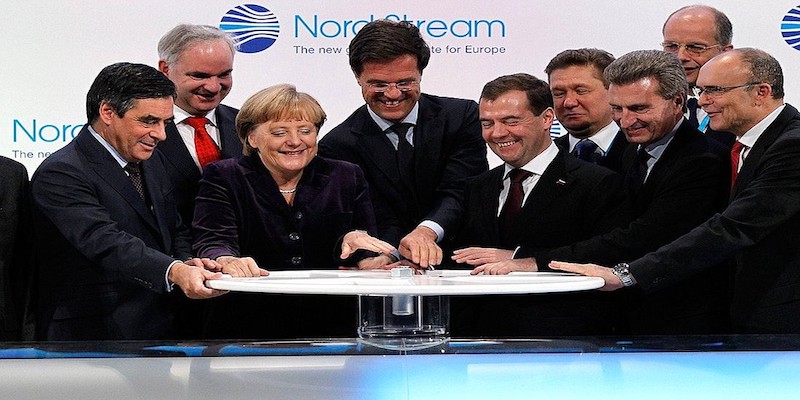
John Szabo writes on the Nord Stream Two gas pipeline, and how it’s divided opinion across Europe and with its allies, and how it could affect EU and NATO projects in the foreseeable future. Germany wants to move forward, but that means that the Cold-War frontlines between East and West could be pushing further west.
Following the August signing of the Convention on the legal status of the Caspian Sea, the Southern Gas Corridor (SGC), a large-scale gas pipeline project that aspires to connect the region’s copious hydrocarbon resources to the European markets, has been drawn back into international debate. The present article illuminates how the SGC enhances the Read More…