Recently, Canada has been making strides to strengthen diplomatic and strategic relations with Indo-Pacific countries, despite Canada’s relations with countries such as China having been strained in past years. This shift to the Indo-Pacific in pursuit of trade, economic, and defence opportunities marks a strategic pivot away from a dependence on the US to create key partnerships and establish diplomatic ties. Notably, this highlights an additional avenue for Canada to leverage its soft power, by actively championing the Women, Peace, and Security (WPS) agenda, where the US seems to have abandoned the cause. This presents an opportunity for Canada to further engage with Indo-Pacific partners in security and defence-related activities, with the WPS agenda at the forefront, while positively contributing to Canada’s normative reputation in the region and international visibility.
While the United States has historically been Canada’s greatest trade, security, and geostrategic ally, this relationship has grown increasingly unreliable since President Donald Trump was elected to office in 2016, and again in 2024. This shift was highlighted during Prime Minister Mark Carney’s pivotal speech at the World Economic Forum in Davos earlier this year, where Carney outlined Canada’s new position as a “middle power” in an increasingly unstable global environment. Here, he emphasized the need for closer cooperation between Canada and other allies to diversify trade, strengthen economic resilience, and increase defence and security partnerships in the midst of growing uncertainty.
When compared with US unpredictability, Carney has raised Canada’s profile as a pivotal coalition builder on the international stage. Recent conflicts around the globe, coupled with President Trump’s threats to withdraw from NATO, have only strengthened the case for middle powers to diversify away from the US, which no longer presents as a reliable trade, security or ideological ally. In addition, the Trump administration has significantly rolled back many previous WPS commitments. The agenda recognizes that conflict and security have a disproportionately negative impact on women and girls, and works towards integrating their perspectives and participation in conflict resolution through four key pillars: participation, prevention, protection and, relief and recovery. Given this geopolitical context, Canada is positioned to rebalance the role of values in its foreign policy, specifically as it pertains to its activities in the Indo-Pacific.
Canada’s principal Indo-Pacific policy document, the Indo-Pacific Strategy, was released in 2022. Though it was published in a vastly different global environment, it remains relevant in highlighting various economic, trade, and innovation opportunities, and also outlines strategic priorities, such as promoting peace and security in the region. Here, the strategy recognizes the importance of the Indo-Pacific to global and domestic security; Canada has recently revitalized ties with key players such as India and China despite historically rocky relations, and strengthened partnerships with allies like Australia and Japan. This includes increased military, economic, and trade partnerships, in addition to strengthening supply chains and export opportunities in energy and critical minerals with relevant regional blocs such as the Association of South East Asian Nations (ASEAN) and Asia Pacific Economic Cooperation (APEC).
Notably, Canada’s defence strategy continues to demand an Indo-Pacific lens, given the US’s unpredictable positioning and a consensus amongst other Asian countries on the threat of China. Canada has been successfully engaging with Indo-Pacific partners with WPS at the centre through increased defence cooperation and military integration exercises, who respect the Participation pillar of the agenda’s foundational principles. The Indo-Pacific Strategy pledged $7.6 million towards advancing the WPS agenda in the region, through frameworks such as the Military Defence Cooperation Program (MDCP). Here, Canada’s Department of National Defence (DND) has partnered with international organizations such as UN Women and nations like Indonesia, Malaysia, Vietnam, and the Philippines to promote WPS objectives of gender equality and inclusivity through various defence projects and initiatives.
In addition, there is an opportunity to integrate the principles of WPS through partnerships that address critical regional security issues, such as climate change. One of four core pillars of the WPS agenda, relief and recovery, highlights the importance of access to food, water, and hygiene products in post-disaster contexts. The Indo-Pacific region is increasingly experiencing natural disasters that have devastating humanitarian and economic consequences. In Canada, a record-setting number of wildfires have occurred in recent years, with compounding effects on rural communities. Understanding disaster response and governance through a WPS perspective is essential to the stability and security of at-risk populations. Here, for example, Canada and Indo-Pacific nations can engage in an exchange of support as a framework to build stronger relations. Canada can continue championing the WPS agenda by contributing its expertise in this domain as it relates to disaster relief, and Indo-Pacific countries can share best practices and response mechanisms to address the effects of natural catastrophes.
Not only is following through with tangible initiatives key in establishing a consistent Canadian presence in the Indo-Pacific important, but also establishing a norms-based presence driven by promoting core values and principles, such as those detailed in the WPS agenda. At the founding of NATO, Canada and other allies committed to “promoting the principles of individual liberty, democracy, human rights and the rule of law”, in addition to its collective defence pact. This ideal is specifically echoed through commitments driven by the WPS agenda. However, reports of human rights violations, gender discrimination, and forced labour are extremely prevalent in the region, where local governments and authorities are often complicit. For example, international authorities have repeatedly accused China of enforcing repressive measures and committing crimes against humanity. Therefore, given the prevalence of gender-based violence and discrimination that is persistent across Asia, Canada must find a balance between establishing strategic partnerships and ties while simultaneously maintaining its values and normative reputation. The new channels and diplomatic ties that have been opened through pursuing opportunities in trade and the economy provide a strategic opening for Canada to exert influence on WPS values in the Indo-Pacific.
In this new geopolitical landscape, Canada is being recognized around the globe as an engaged and dependable ally, from security and defence to trade and energy, but also in principles. It is in Canada’s interest to continue cooperating with Indo-Pacific countries through multiple frameworks, by integrating WPS into defence and military operations, trade policy, and humanitarian aid efforts. At this crucial moment, Canada is positioned to redefine its relationships with Indo-Pacific countries and its position amongst allies. By simultaneously maintaining a strong commitment to the WPS agenda and its core values and continuing to forge new partnerships and relations, Canada’s strategic objectives can be supported and reinforced.
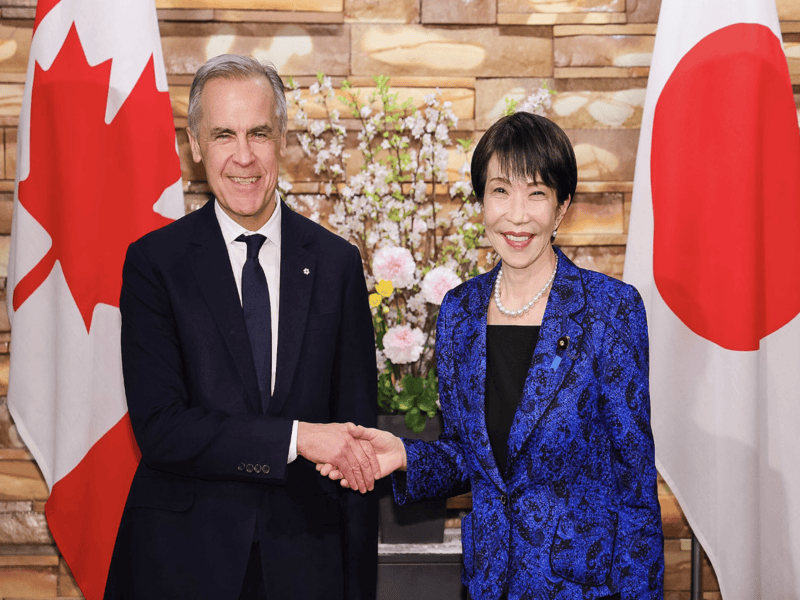
Image: Japan-Canada Summit Meeting, 首相官邸ホームページ, CC BY 4.0, via Wikimedia Commons.
Disclaimer: Any views or opinions expressed in articles are solely those of the authors and do not necessarily represent the views of the NATO Association of Canada.




.jpg)
